OnlyFans Chatter Training: Persona Notes, Limits, QA Review and the Role Beside AI
OnlyFans chatter training is the onboarding that turns a hired chatter into someone who can write one specific creator's messages without supervision: her voice, her limits, what may be sold and at what price, which threads to hand on, and how to leave notes the next shift can use. This page is for the creator or agency doing the training, after the hire is made. It covers what to put in the persona notes, how to use scripts as drills, a staged onboarding plan, how to review threads, and what a human chatter does once AI writes the routine replies.
- What to teach that a hiring test cannot check
- A one-page persona sheet the chatter learns from
- Scripts as drills, judgement as the skill being trained
- Sales and consent limits written as rules, not vibes
- A thread-by-thread QA review that teaches instead of grading
What OnlyFans Chatter Training Has to Teach
OnlyFans chatter training teaches what only this creator and this team know; the general skills were already checked when you hired. Writing well, keeping a conversation going and staying calm with explicit topics are what a candidate shows in the test — the applicant's view of that test is described in what the chatter job asks of applicants. Training starts where the test stops: with one person's voice, one set of limits and one content library.
That is also why a paid "chatter course" rarely replaces onboarding inside the team. A course can describe general technique, but it cannot know that this creator never uses emojis, does not discuss her city, and wants every custom request sent to her manager. If an agency asks a new hire to pay for training before the first paid shift, treat it as a warning sign, not as a sign of seriousness.
- Voice: how she writes, the words she uses and the ones she never would
- Limits: topics, promises and offers that never happen, whatever the fan says
- Handover rules: what the chatter does not decide, and who does
- Vault and prices: which files may be offered, and inside which price range
- Notes: what to record on each fan so the next shift does not start from zero
The Persona Sheet: One Page a New Chatter Can Learn From
A persona sheet is the single document that lets any chatter write a message that sounds like yesterday's. It works best as pairs of "she writes / she does not write" examples rather than adjectives: "playful" means something different to every reader, while "lowercase, short lines, a bracket smile instead of emojis" means one thing. The creator writes it, or her manager writes it with her — never the chatter by guessing.
Keep it to a page and keep it current. When reviewers make the same correction three weeks in a row, the sheet is missing a rule or states one badly, and fixing the sheet saves more time than correcting each chatter separately.
- Capitals and punctuation: lowercase or not, full stops, ellipses, emojis
- Length and rhythm: one long message or several short ones
- Pet names and words she uses, and the ones she never uses
- Facts about her that may be mentioned, and those that may not
- Hard limits: meeting up, personal contact details, topics she does not do
- What to do when the sheet has no answer: ask, never invent
Scripts Versus Judgement: What Each Is For in Training
In training, scripts are drills for recurring situations; judgement is the skill being trained, and it is what you actually review. A welcome to a new subscriber, an answer to "that's too expensive", a fan who has gone quiet, a request for a custom: for each one the new chatter should see an example rewritten in this creator's voice. A library of OnlyFans chat templates for each conversation stage is a reasonable starting point for the drills.
The test of training is the message no script covers. A useful exercise: give the trainee five invented fan messages and ask for replies in the creator's voice, and make one of the five a message that should be handed on rather than answered — a custom request, a refund question, a fan who says something worrying. Grade the replies against the persona sheet, not the reviewer's taste. A script pasted unchanged is a mistake, not a time saver: a fan who receives the same line twice knows he is talking to a template.
Sales Boundaries: What a Trainee May Offer, and How
Sales boundaries are written rules about what a chatter may offer, at what price and when to stop, and a new chatter should be able to recite them before the first unsupervised shift. Most damage from new chatters is not a weak sale but an overreach: a discount nobody approved, a custom promised at a made-up price, a file offered that the fan already bought, or a third push after a clear no.
Put the price side in writing per category and per type of file, the way a creator sets price ranges for her PPV files, and say who may go outside them (usually nobody on a shift). Then train the timing: an offer that follows from the conversation, not one sent because the shift has a target.
- Offer only files the creator has approved for sale
- Price only inside the range set for that category and file type
- Never offer a file the fan already owns — check the notes first
- One clear "no" ends the offer for that conversation
- Discounts, bundles and customs go to the person who decides them
Consent and Limits: What Is Taught Separately and Checked Hardest
Consent and limits are trained as their own module because a mistake here costs more than an awkward sentence. Three kinds of consent are involved: the creator's consent to how she is represented (only what the persona sheet allows), her consent to what is sold (only approved content, never a promise of content she does not make), and the fan's — a fan who says stop, or who seems distressed, is not a sales opportunity.
A new chatter must know without asking which conversations are never theirs to continue. High spenders are a separate case: the creator's biggest-spending fans are usually kept with one experienced person, and a trainee should learn to pass such a fan on with a clear note rather than try to close a sale.
- Requests to meet, or for personal contact details or her location
- Anything suggesting the fan may be underage: stop and escalate at once
- Threats, self-harm, or a fan in obvious distress
- Custom requests, refunds, complaints and chargeback threats
- Requests for content outside the creator's written limits
A Staged Onboarding Plan: From Shadow Shift to Solo
Onboarding works in stages, and each stage ends on a signal from reviewed threads, not on a date. How many shifts each stage takes depends on the person and on the account; what matters is that the lead moves the trainee forward after reading their work.
- Reading: the persona sheet, the handover rules and a set of recent threads; the trainee writes down what is unclear
- Shadow shift: the trainee drafts replies beside an experienced chatter; nothing is sent
- Supervised shift: the trainee replies, and the lead reads every thread at the end of the shift
- Selling unlocked: offers are allowed once everyday threads stop needing correction
- Solo: review drops to a sample, and handovers happen without reminders
- Ready signal: the same correction stops appearing in review
QA Review: How to Read a Trainee's Threads
QA review for a chatter reads whole threads, not single messages and not the shift's sales total. A sentence can be fine while the thread goes wrong: the chatter asked something the fan had said yesterday, or offered a file he had already bought. In a team with several creators and shifts, the review belongs in a wider exception queue for agency chat teams so the same correction is not made five times by five people.
Write a correction, not a score: what was there, what it should have been, and which rule on the persona sheet covers it. Review that names the rule teaches; review that only gives a mark is an exam. The example below is invented for illustration — it is not a real conversation or a real result.
Example. Fan: "bought the shower set last week, got anything new?" Trainee: "hey babe!! 😍 I have a hot shower set just for you, only for today!" Correction: three rules broken — the creator writes lowercase without emojis; the fan already owns that set (it was in the notes); and "only for today" is an invented deadline. Better: "you liked that one huh :) i made something new this week, want to see?" — then an approved file he does not have, at a price inside its range.
- Does the thread sound like the creator, not like the chatter?
- Did the trainee ask something already in the notes?
- Was anything offered that was already bought, or pushed after a no?
- Was a thread continued that the rules say must be handed on?
- Is there a note the next shift can pick the conversation up from?
How AI Chatter and AI Sexter Change What You Train a Human For
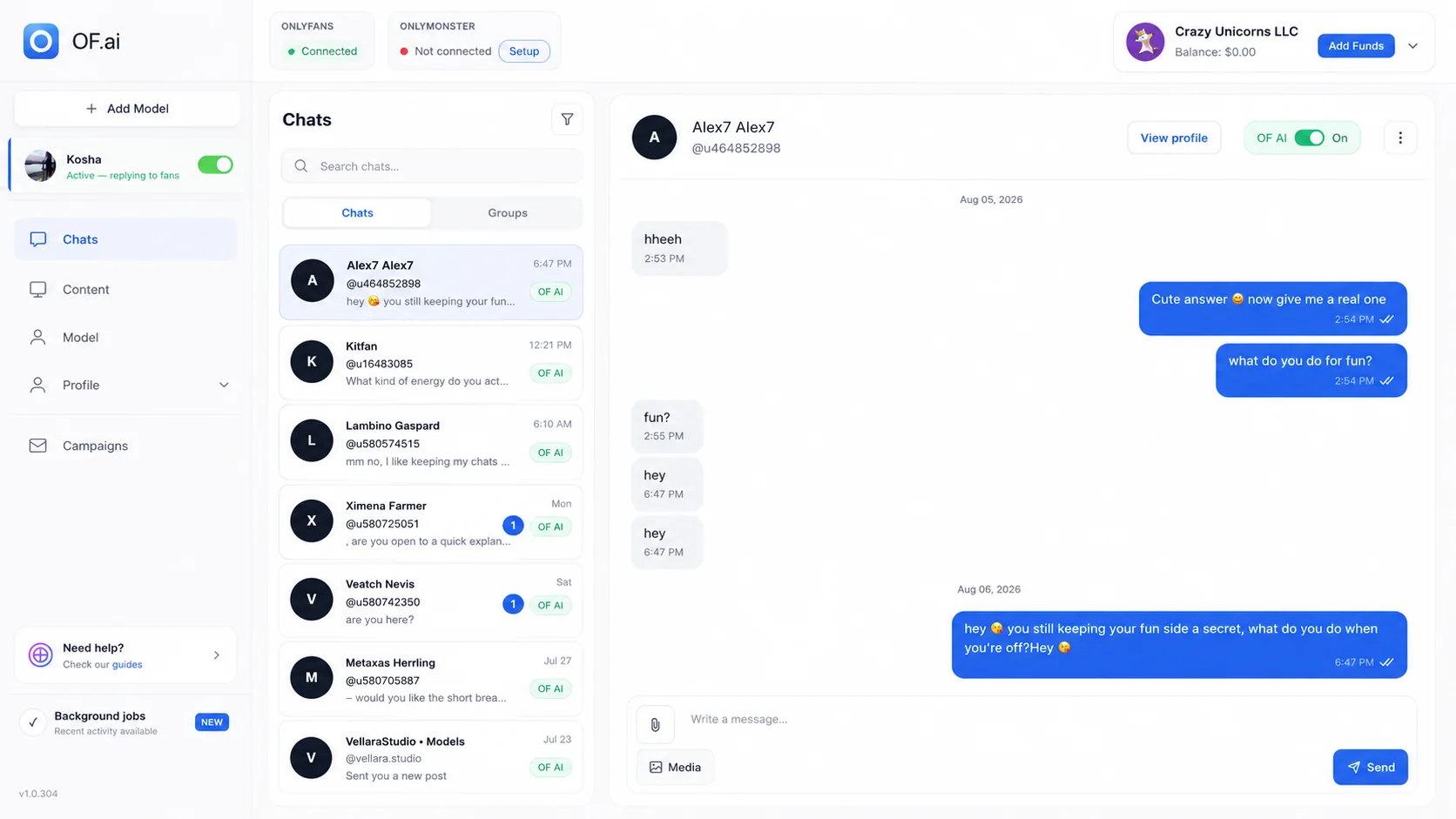
When AI writes the routine replies, a human chatter is trained less for volume and more for reading, taking over and correcting. On OF.ai, AI Chatter, which answers fans and sells nothing, is free forever on the account's first model; selling then stays with people, so the sales-boundary module above is still taught in full. AI Sexter, the mode that also offers PPV, offers only files from the creator's own approved vault at prices inside the ranges she sets per category, so the trainee's sales work shifts to checking those ranges and the approved set rather than pricing each offer by hand. AI Sexter has two plans, Start and Pro, compared on OF.ai's plans and prices page.
In either mode, any chat can be taken over by a person at any moment, and that takeover is what the human is now trained for: custom requests, complaints, high spenders, anything from the consent module. The persona the creator fills in for the AI is, in practice, the persona sheet above, so a new chatter should read it first. The AI does not train itself on the chats; it changes only when someone edits its instructions, and OF.ai tests instruction changes in a test lab before they reach live chats — so a trainee's most useful output is often a precise note on where the AI drifted from the creator's voice. Each OnlyFans account works through its own dedicated residential IP, so nobody needs the creator's password on a personal device to do any of this.
- Read AI threads daily and flag where the tone slipped
- Take over threads the AI should not continue, and leave a note
- Suggest persona edits with a quoted example, not a general complaint
- Flag files that should or should not be in the approved vault
Common Mistakes When Training OnlyFans Chatters
Most problems with a new OnlyFans chatter come from how they were onboarded, not from their ability, and the same mistakes show up in teams of every size. Who to hire in the first place is a separate question, covered in how to choose and test a chatter hire.
- Giving account access before the trainee has read the persona sheet and handover rules
- Training with scripts that are then pasted unchanged
- Judging a trainee by shift sales without reading the threads
- Sharing the creator's password in a group chat instead of giving access through a work tool
- Leaving the persona sheet unchanged while the same correction repeats
- Handing a trainee the account's biggest spenders in the first week
FAQ
How do you train an OnlyFans chatter?
Train an OnlyFans chatter in stages. First they read the creator's persona sheet, her limits and the handover rules. Then they draft replies on a shadow shift without sending. Then they reply while a lead reads every thread after the shift, and selling is unlocked once everyday threads stop needing correction. They work alone when the same correction stops appearing in review.
Do I need to pay for an OnlyFans chatting course?
A paid course is not required to become or train an OnlyFans chatter. The core of the training — one creator's voice, limits, prices and handover rules — is known only to the team that runs her account. A course can explain general chat technique but cannot replace onboarding. An agency that asks a new chatter to pay for training before the first paid shift is a warning sign.
What should a chatter onboarding document include?
A chatter onboarding document should include the creator's writing style as examples (capitals, punctuation, length, emojis, pet names), facts that may and may not be mentioned, hard limits, which files may be offered and inside which price ranges, which conversations are handed on and to whom, and what to record about each fan for the next shift.
How does AI change OnlyFans chatter training?
When AI writes routine replies, a human chatter is trained to read AI threads, flag where the tone drifted, and take over conversations the AI should not continue. With OF.ai any chat can be taken over by a person at any moment, and the AI does not train itself on chats, so a chatter's precise notes are what lead to edits in its instructions.
AI Chatter for OnlyFans.
Start free. Stay free.
Let AI chat with your fans 24/7 using your persona and tone of voice. Keep human control and upgrade only when you want AI selling. Free on the first model of your account; additional models use AI Sexter.