OnlyFans AI Chatter for Agencies That Need More Chat Coverage
When inbox volume grows, agencies usually add shifts, handoffs, and more training. OF.ai gives each model a supervised AI chatter workflow: separate persona and content rules, fan context, configurable conversation stages, per-fan AI control, and instant human takeover. Start with one model and measure whether you cover more repeatable conversations with less operator switching — while keeping sensitive or high-value chats under human control.
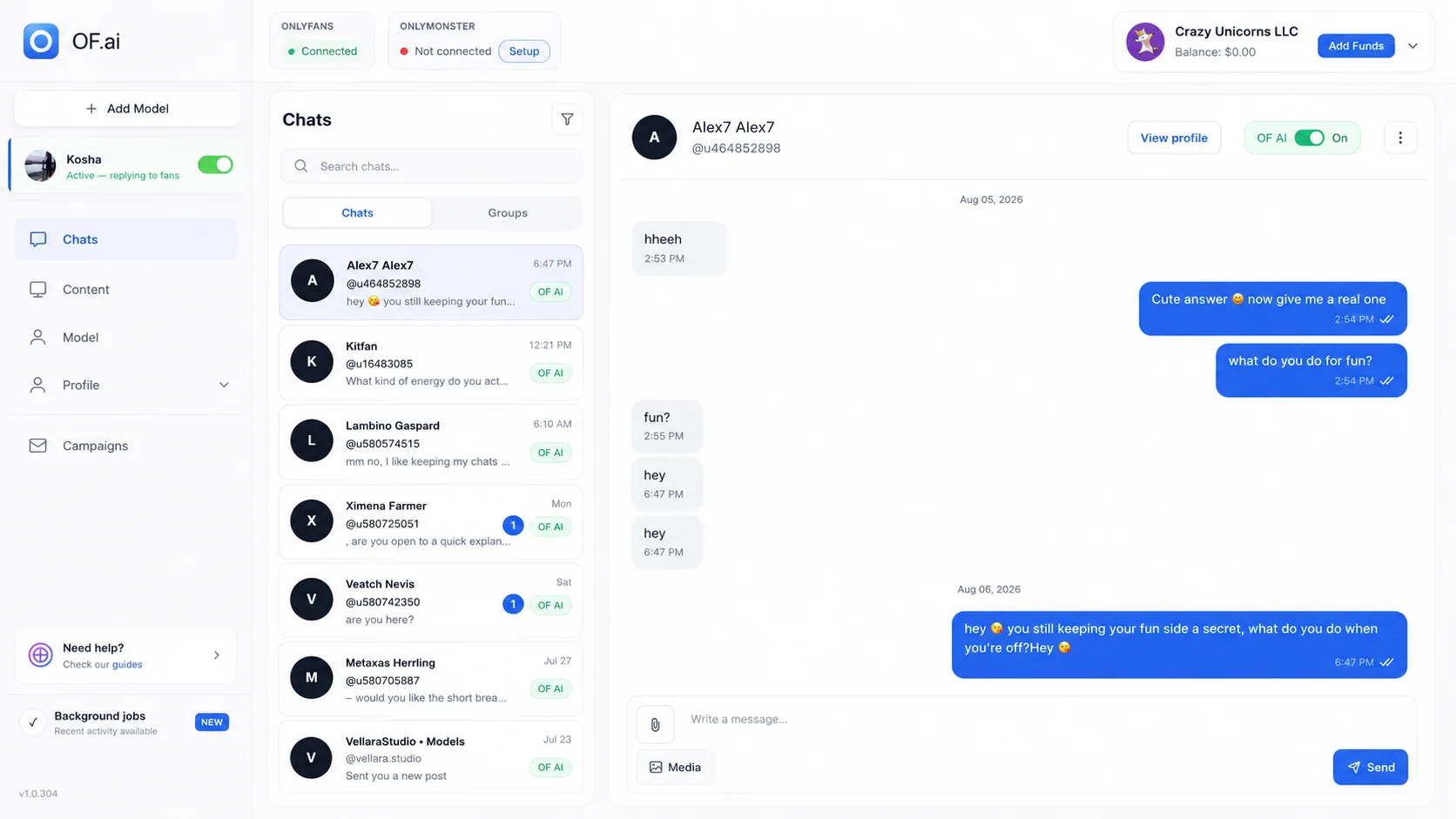
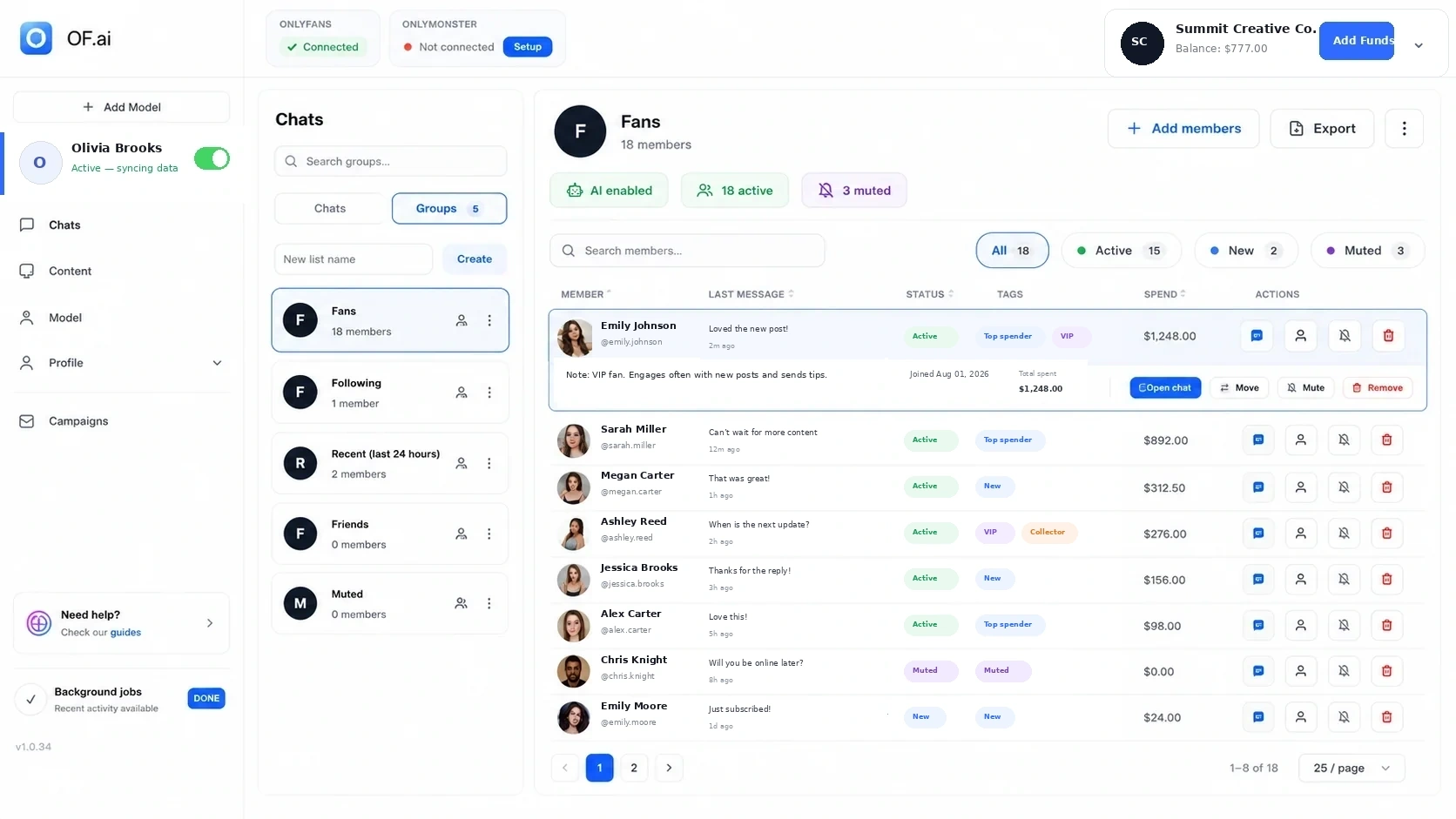
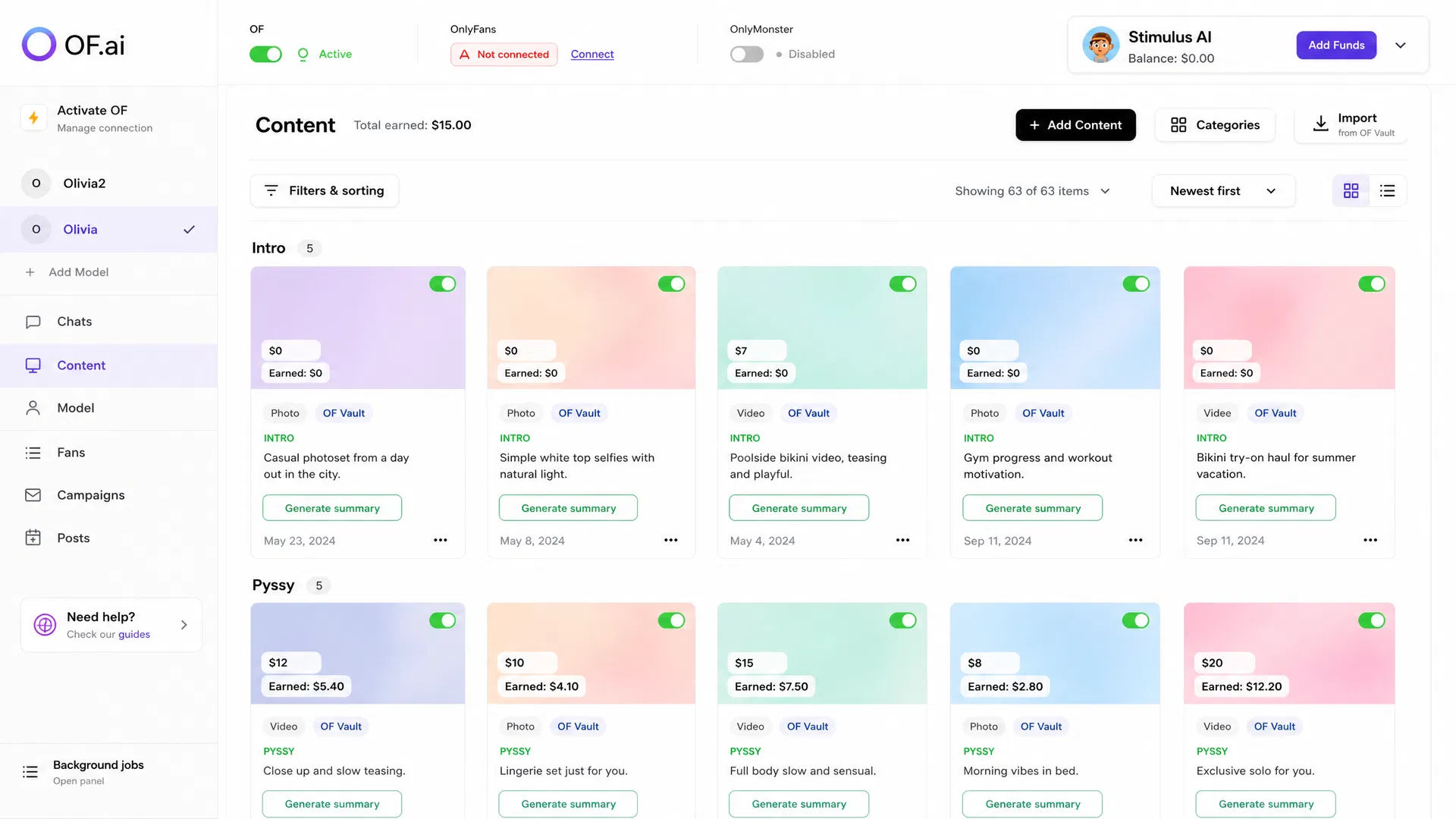
- Handle repeatable first replies, follow-ups, and approved-content workflows without adding another manual queue
- Keep each model's persona, boundaries, content, and fan context separate
- Turn AI off or take over any fan conversation without changing the rest
- Pilot on one model and compare coverage, corrections, review time, and sales outcomes
What Changes for an Agency Team
The operational cost of chat is not only typing. Managers also deal with shift changes, handoffs, repeated coaching, searching for the right content, and making sure a reply follows the correct model's voice and rules. Those tasks become more visible as the roster grows.
A supervised AI chatter workflow moves repeatable work into one operating layer. The assistant works from the model-specific persona, fan context, conversation stage, approved content, and configured rules, while the operator sees the same thread and can step in whenever judgement is needed.
How the Supervised AI Chatter Workflow Works
- Keep each creator's persona, tone, boundaries, and approved examples in separate configuration
- Use fan history, tags, purchases, and stated preferences as conversation context where the connected integration provides them
- Move through configurable conversation stages instead of using one prompt for every situation
- Reference approved content and configured offer rules inside the same chat workflow
- Switch AI off per fan or take over the thread when a conversation needs a person
- Review corrections and takeovers before expanding automation to more fans or models
Where Humans Stay in Control
Automation is most useful when the boundary is obvious. Routine first replies, follow-ups, content discovery, and configured offers are easier to standardize than sensitive requests, unusual situations, or conversations where an agency wants direct operator attention.
OF.ai keeps control at the conversation level. A team can leave selected fans manual, take over a live thread, review what the assistant was instructed to do, and adjust the model-specific workflow without changing every other creator in the agency.
What to Measure in a One-Model Pilot
| Signal | What to record | Decision it supports |
|---|---|---|
| Chat coverage | Target conversations answered during your normal operating window | Whether repeatable conversations are being covered more consistently |
| Corrections | Replies edited, rejected, or flagged during review | Where persona, stage, or boundary rules need work |
| Human takeovers | Chats moved from AI to an operator | Which situations should remain manual |
| Review load | Manager or operator time spent reviewing the workflow | Whether automation removed work or merely moved it into supervision |
| Commercial outcomes | The offer, purchase, and revenue measures you already trust | Whether the new workflow is commercially useful without lowering your quality bar |
Built for Multi-Model Agencies
Each model can keep separate persona settings, content, conversation rules, and fan context while agency managers work from one workspace. That separation matters because scaling one creator workflow across a roster should not mean mixing voices, content, or operating rules.
Add models gradually. A model-by-model rollout makes configuration errors easier to identify and gives managers a cleaner baseline for deciding where automation helps and where human handling should stay the default.
Define the Responsibility Split Before the Pilot
An AI chatter should not have an undefined job. Decide which repeatable stages can be AI-assisted, which remain operator-owned, and which require manager or creator judgement. The split can differ by model and can change as the team learns from real conversations.
Keeping that responsibility map explicit makes takeovers easier to interpret. A takeover is not automatically a failure; it may be the expected owner change for a stage the agency deliberately kept manual.
| Responsibility | Typical owner | Control to define |
|---|---|---|
| Repeatable opening / follow-up | AI-assisted workflow or operator | Persona, stage, allowed context, frequency, stop rules |
| Content selection from approved library | AI-assisted workflow with review policy | Asset metadata, availability, price, eligibility |
| Sensitive or custom request | Operator or senior reviewer | Escalation reason and required source context |
| Repeated quality problem | Manager | Correction category and configuration change |
| Creator-only decision | Creator or designated owner | Concise handoff with the underlying thread available |
What a Manager Reviews Each Day
Managers do not need to reread every automated conversation. A more useful routine is to review exceptions, a representative quality sample, correction categories, unresolved takeovers, and any change in review workload. The purpose is to find where the operating rules need attention.
Review by model before averaging across the roster. A change that works for one creator may fail for another because tone, content mix, audience, pricing, and conversation complexity differ.
- New or repeated correction categories
- Takeovers that happened too late or without enough context
- Cross-model content or persona mistakes
- Manual-only fans accidentally entering automation
- Review minutes and unresolved exception backlog
- Commercial outcomes using the agency’s existing definitions
FAQ
Can an AI chatter replace my whole chatter team?
That depends on how much of your chat volume is repeatable and how much requires judgement. Start with one model, keep review and takeover available, and compare coverage, corrections, review time, and commercial outcomes before changing staffing assumptions.
Can I keep VIP or sensitive fans manual?
Yes. AI control is per fan, so selected conversations can remain manual while other repeatable workflows use automation.
How do I keep each model's voice separate?
Keep persona, tone, boundaries, approved examples, content, and stage instructions model-specific. Review early conversations for drift before expanding coverage.
How do I reduce the risk of the wrong content being used?
Use the approved-content workflow, explicit content metadata, and human review during rollout. Only widen automation after the content rules and permissions behave correctly on real conversations.
What metrics should an agency track?
Track chat coverage, response-time distribution, corrections, takeovers, review workload, and the commercial metrics you already use. Compare the same account before and after the workflow change.
Can I test OF.ai on only one model first?
Yes. A one-model pilot is the recommended way to understand the workflow, identify configuration issues, and build a first-party baseline before expanding to the rest of the roster.
What should a manager review every day during an AI chatter pilot?
Review exceptions, a representative sample of ordinary conversations, correction categories, takeovers, cross-model mistakes, and review workload. Use model-level context before changing a rule for the whole agency.
Next step
Connect One Model and Test the Workflow
Connect one model, keep human review on, and test this workflow against your own baseline.