OnlyFans Agency Software for Multi-Model Chat Operations
As an agency grows, the hard part is keeping every model's voice, fan context, content, and operating rules separate while managers still see what needs attention. OF.ai gives each creator a separate supervised chat workflow inside one agency workspace, with model-specific persona and content, fan context, per-fan AI control, and human takeover. Start with one model before moving an agency-wide process.
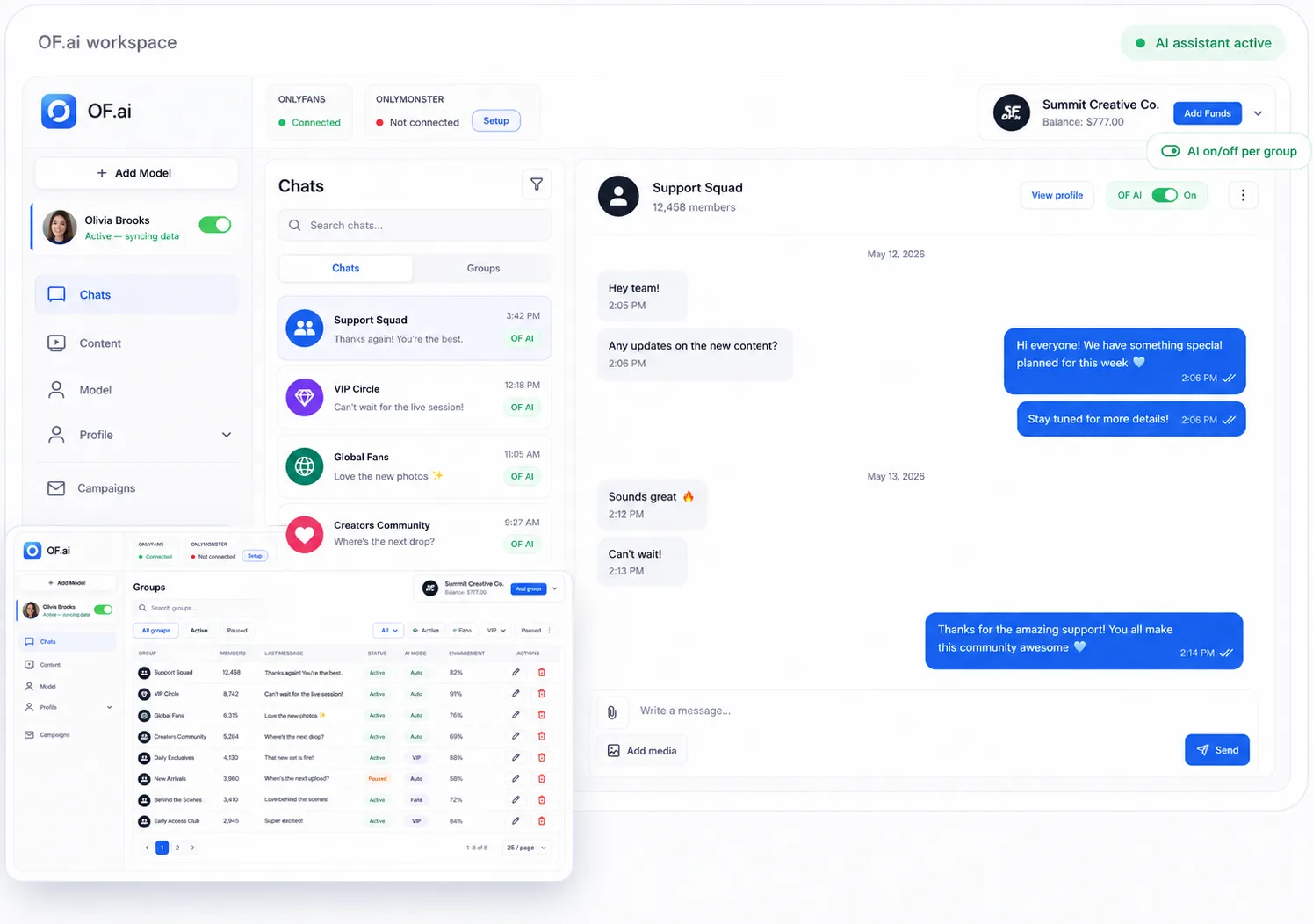
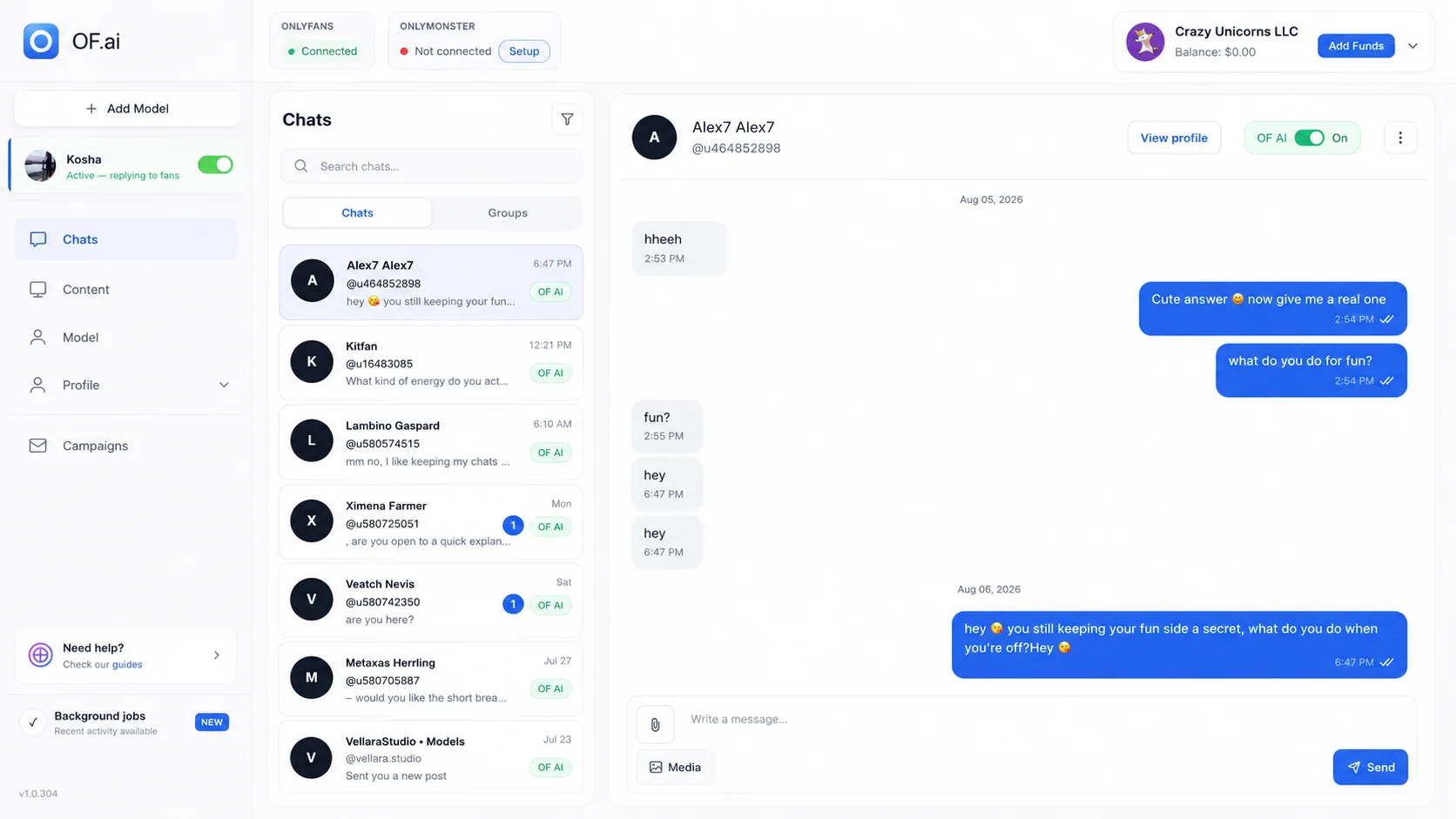
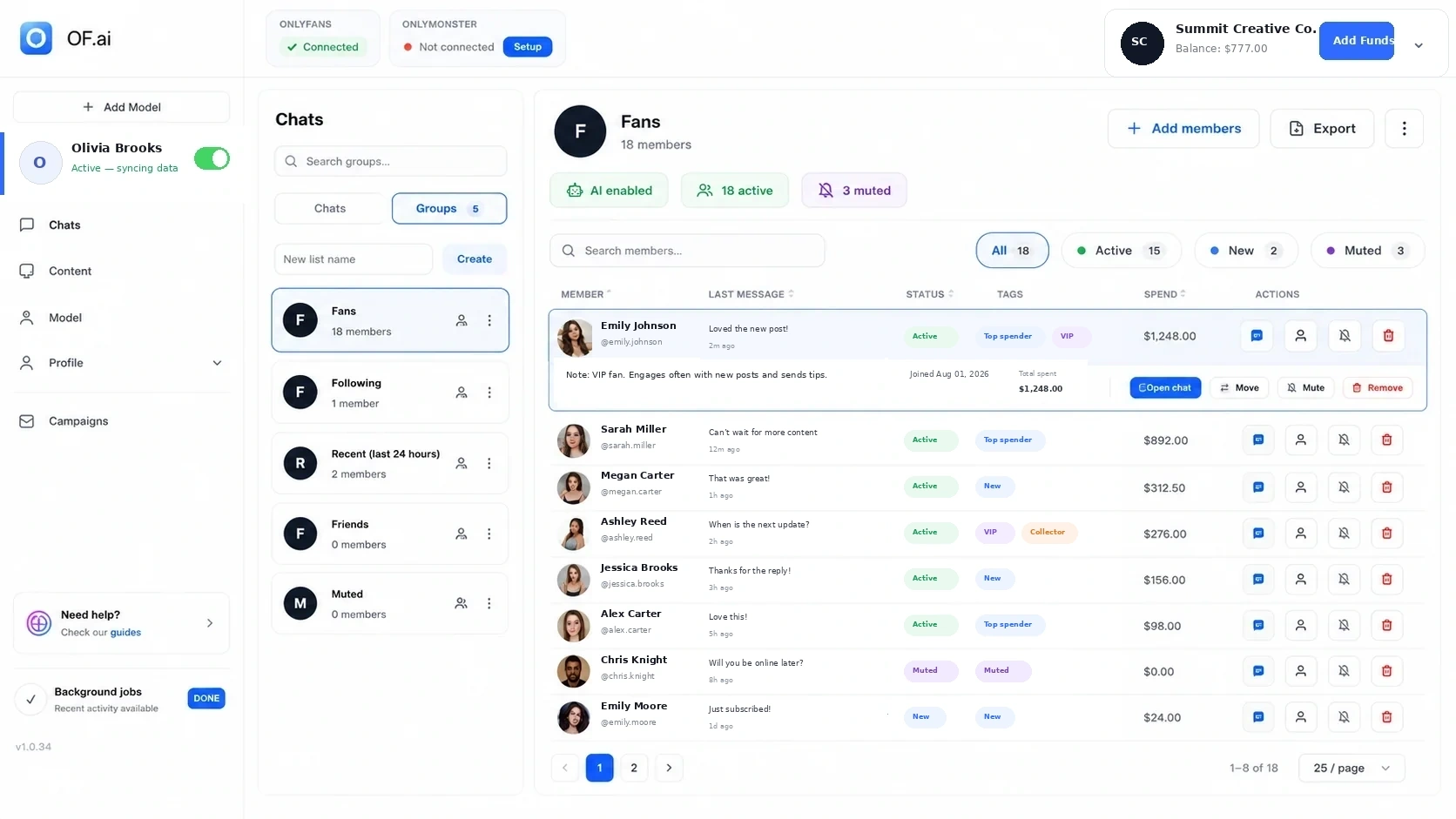
- Separate persona, content, conversation rules, and fan context for each model
- One workspace for managers to oversee multi-model chat operations
- Per-fan AI control and human takeover for exceptions or sensitive conversations
- Model-by-model rollout so operating improvements and mistakes stay attributable
What Breaks When Agencies Scale Manually
More models usually mean more context switching: operators move between accounts, managers repeat the same coaching, content is stored in more places, and handoffs become harder to audit. The risk is not only slower work; it is using the wrong model's context, content, or rules in the wrong conversation.
Agency software should reduce that coordination burden. The useful question is whether managers can see and control the work from one operating layer while every creator still has a separate configuration and content context.
One Operating Layer, Separate Creator Contexts
- Model-specific persona, tone, boundaries, and conversation-stage instructions
- Separate approved content libraries and configured offer rules
- Fan history, tags, purchase context, and stated preferences attached to the correct conversation where available
- Unified agency oversight without merging one creator's operating context into another's
- Per-fan AI control and human takeover for exceptions
- Model-level measurement of corrections, takeovers, review load, and commercial outcomes
What Managers Should Be Able to See
| Management question | Workflow signal | Why it matters |
|---|---|---|
| Which chats need a person? | Manual fans, takeovers, escalations, correction reasons | Keeps human attention on the exceptions |
| Are model contexts staying separate? | Cross-model mistakes and configuration changes | Tests whether the agency setup is working safely |
| Is the team covering more repeatable work? | Chat coverage, response-time distribution, review minutes | Shows whether software is reducing coordination |
| Is the workflow commercially useful? | The offer, purchase, and revenue metrics you already trust | Connects operating changes to outcomes without assuming causation |
A Fit Check Before You Buy
OF.ai is most relevant when the agency wants to automate repeatable fan conversations while preserving model-specific rules, approved content, manager visibility, and human takeover. It is not automatically the right replacement for every system in an agency stack.
- Good fit: supervised AI chat, model separation, approved-content workflows, fan context, and human takeover are central requirements
- Compare carefully: your primary need is a broad multi-platform CRM, payroll, shift scheduling, or workforce management
- Pilot first: use one creator whose current workflow and baseline are already understood
Roll Out Model by Model
Start with one creator, configure persona, content, stages, offer rules, and escalation behavior, then keep human review on while the team reads real conversations. Classify corrections and takeovers rather than treating them as one bucket.
Add the next model only after the first workflow meets your own quality and operating targets. A model-by-model rollout keeps configuration problems attributable and makes staffing or process decisions easier to defend with first-party data.
Evaluate Agency Software by the Control Surface
A feature checklist is not enough for a multi-model agency. Evaluate what managers can actually see and change: creator separation, team permissions, exception ownership, approved content, workflow rules, QA history, and model-level reporting. The useful question is whether the software makes operating decisions easier to inspect.
A system can have many dashboards and still create more management work if the manager cannot trace a correction to the model, rule, asset, or handoff that caused it.
| Control surface | Agency question | Evidence to inspect |
|---|---|---|
| Creator separation | Can one model’s persona, content, and fan context stay isolated? | Model-specific configuration, libraries, and QA history |
| Permissions | Who can view, edit, review, or take over? | Role and model access settings |
| Exception ownership | Who owns a sensitive or unresolved thread? | Takeover state, escalation reason, and assigned reviewer |
| QA | Can repeated mistakes be grouped by cause? | Correction categories and configuration history |
| Portfolio reporting | Can managers compare models without hiding local context? | Consistent definitions plus model-level drill-down |
Migration Checklist for an Existing Agency
Do not migrate every model and workflow on the same day. Start by documenting the current sources of truth for persona guidance, approved content, pricing rules, fan notes, operator permissions, and escalation. Decide which system owns each item after the migration so the team does not maintain conflicting copies.
Then move one representative model, keep the old process available during the pilot, and compare the same definitions for workload and quality. Expansion should follow a stable control loop, not a deadline.
- Inventory persona and boundary guidance for the pilot model.
- Identify approved content, current metadata, and configured prices.
- Map operator and manager access before connecting the account.
- Define takeover, escalation, and offboarding responsibilities.
- Record baseline review minutes, corrections, and handoff friction.
- Expand only after managers can explain the new workflow end to end.
FAQ
Can every model have different persona and content rules?
Yes. Keep persona, approved examples, content, conversation stages, boundaries, and escalation rules separate for each model, then review early conversations for drift or cross-model mistakes.
How many models can one team manage with OF.ai?
There is no universal number. Capacity depends on conversation volume, complexity, integrations, configuration quality, and how much human review your agency keeps in the workflow.
Can managers take over a fan conversation?
Yes. Human takeover is part of the supervised workflow, and AI can also be left off for selected fans while other conversations remain automated.
What should managers monitor during rollout?
Monitor corrections, takeovers, review minutes, chat coverage, configuration changes, and the commercial outcomes the agency already tracks, preferably at model level before rolling them up across the roster.
Does OF.ai replace payroll or shift-scheduling software?
OF.ai is centered on supervised chat automation and creator operations. If payroll, shift scheduling, or broad workforce management is your primary requirement, compare dedicated CRM or workforce products for those workflows directly.
What should an agency migrate first?
Start with one model whose current workflow is understood. Move the minimum set of persona rules, approved content, fan context, permissions, and escalation controls needed to test the chat operation before migrating the rest of the roster.
Next step
Connect One Model Before Moving the Agency
Connect one model, keep human review on, and test this workflow against your own baseline.