OnlyFans Revenue Optimization: Test Offers Without Guessing
Revenue optimization is a measurement process, not a promise that AI knows who will buy next. Start with observable fan and conversation context, choose one part of the workflow to change, keep attribution stable, and compare the result with the baseline. The goal is to discover which operating decisions improve net outcomes on your account without turning predictions into facts.
- Optimize a workflow variable — not a vague 'AI revenue score'.
- Use observable history, explicit tags, approved content, and configured offer rules as context.
- Change one major variable at a time where practical and document every mid-test change.
- Judge net outcome after review and operating cost, not gross sales alone.
Find the Revenue Workflow Before You Optimize It
Revenue can change because of the offer, content, price, timing, response coverage, follow-up, audience mix, or the conversation that led to the offer. A useful optimization program maps those steps before changing them, so the team can tell what it is actually testing.
Choose a bottleneck the team can observe. Examples include slow content lookup, inconsistent follow-up, offers sent without enough conversation context, unclear configured pricing rules, or a queue that leaves part of the intended coverage period unattended. Do not start from an assumed diagnosis such as 'high-value fans are not being targeted enough' unless you can define and verify what that means from your own data.
Use Known Context — Keep Predictions Labeled as Predictions
| Context type | Use in the workflow | Do not silently turn it into |
|---|---|---|
| Conversation history | Understand what was discussed and what stage the workflow reached. | A claim about private intent or future purchase probability. |
| Explicit tags / notes | Preserve facts or workflow labels recorded by the team. | A personality or spending conclusion the fan never stated. |
| Observed purchases when available | Avoid repeating offers and analyze past response to specific content or prices. | Guaranteed future willingness to buy. |
| Approved content metadata | Match available media and configured offer inputs to the conversation. | A promise that one asset will outperform another. |
| Activity / response history | Describe observed interaction patterns for the measured period. | A churn score presented as a fact. |
Four Revenue Levers You Can Test Separately
| Lever | Example test | What to hold stable |
|---|---|---|
| Conversation coverage | Test a defined coverage window or queue workflow. | Offer rules, content set, and measurement definitions. |
| Offer / price rule | Test one configured offer or price rule for a comparable cohort. | Content category, follow-up logic, and attribution method. |
| Content selection workflow | Improve how approved media is found or matched to explicit context. | Price rule and primary conversation stage. |
| Follow-up workflow | Test whether a defined follow-up rule changes the measured outcome. | Initial offer, eligible cohort, and observation window. |
Design an Offer Test That a Second Person Could Audit
Write down the cohort, dates, offer, content, configured price rule, conversation-stage requirement, follow-up rule, and primary metric before the test starts. Where practical, change one major variable at a time. If the workflow changes mid-test, record the change and time rather than quietly treating the full period as one configuration.
Use a sample large enough that a few purchases do not dominate the conclusion, and report the raw counts beside rates. If the audience is small, treat the result as directional rather than manufacturing certainty from a percentage with a tiny denominator.
- Eligible fan cohort and exclusions
- Conversation stage or trigger
- Approved content and configured offer input
- Primary and secondary metrics
- Attribution window and rules
- Stop conditions for complaints, errors, or boundary failures
- Review workload and corrections
Measure Revenue and the Cost of Producing It
Gross sales can improve while the operating model gets worse. Include software charges, retained human work, review time, correction effort, refunds when relevant to the chosen metric, and any extra management burden introduced by the experiment.
For a buying decision, the useful question is whether the measured contribution after operating cost improved enough to justify the workflow. That connects revenue optimization directly to the automation ROI model instead of treating higher top-line revenue as proof of value.
- Attributed purchases or revenue for the defined scope
- Contribution or margin measure if the business tracks one reliably
- Software / service charges tied to the workflow
- Human review and correction time
- Content and management work added by the test
- Net measured effect compared with the baseline
Segmentation Is Useful When the Rule Is Observable
Segments can make experiments cleaner when the membership rule is explicit: prior purchase of a defined item, a stated preference, a team-applied tag, a conversation stage, or another observed property. They become dangerous when a model-generated label such as 'likely buyer' or 'churn risk' is treated as ground truth without validation.
Keep inferred labels separate from known facts in both the product and analysis. If you test a prediction, validate the prediction as its own experiment before letting it decide who receives a commercial workflow.
How OF.ai Supports a Controlled Revenue Workflow
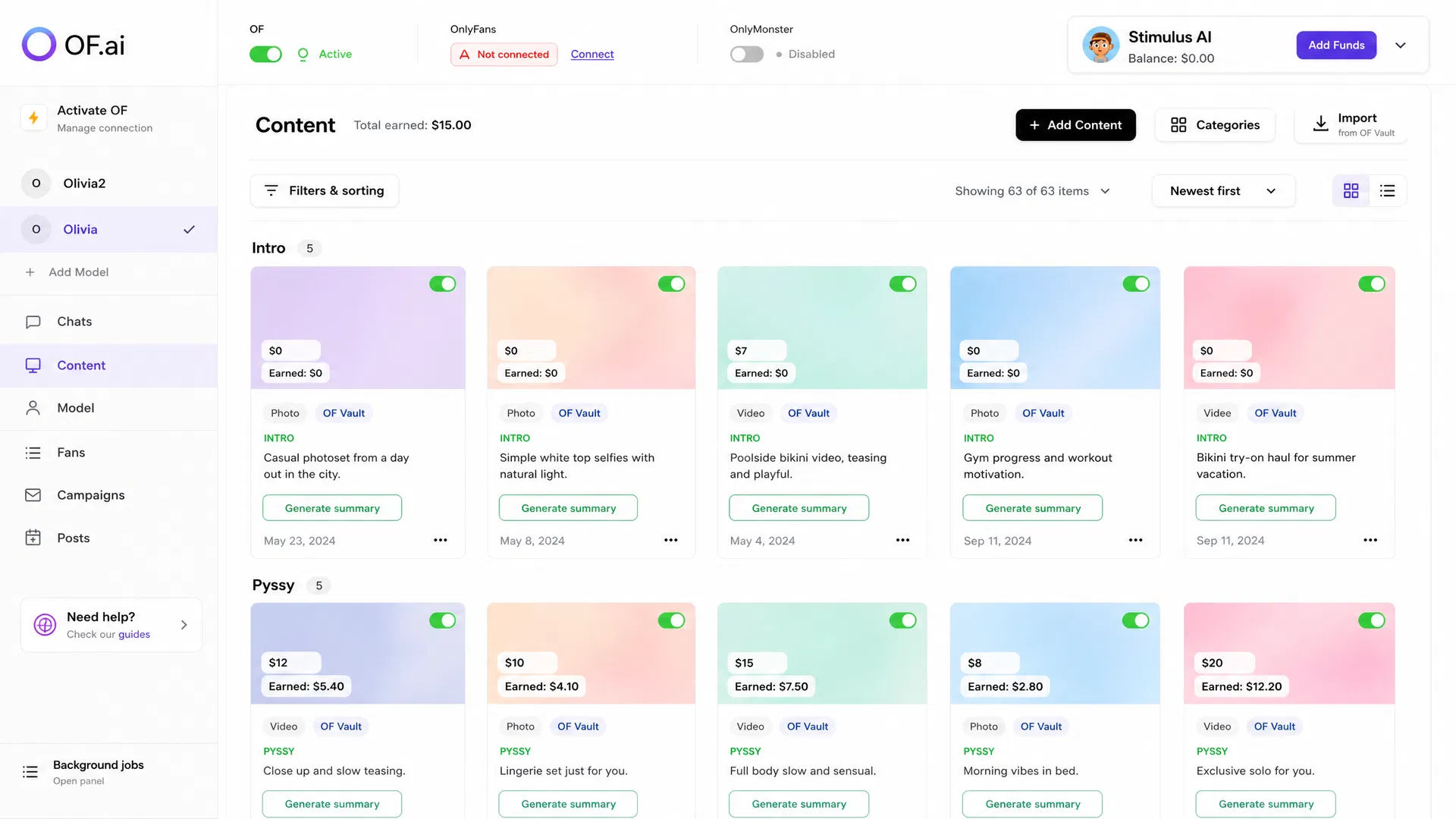
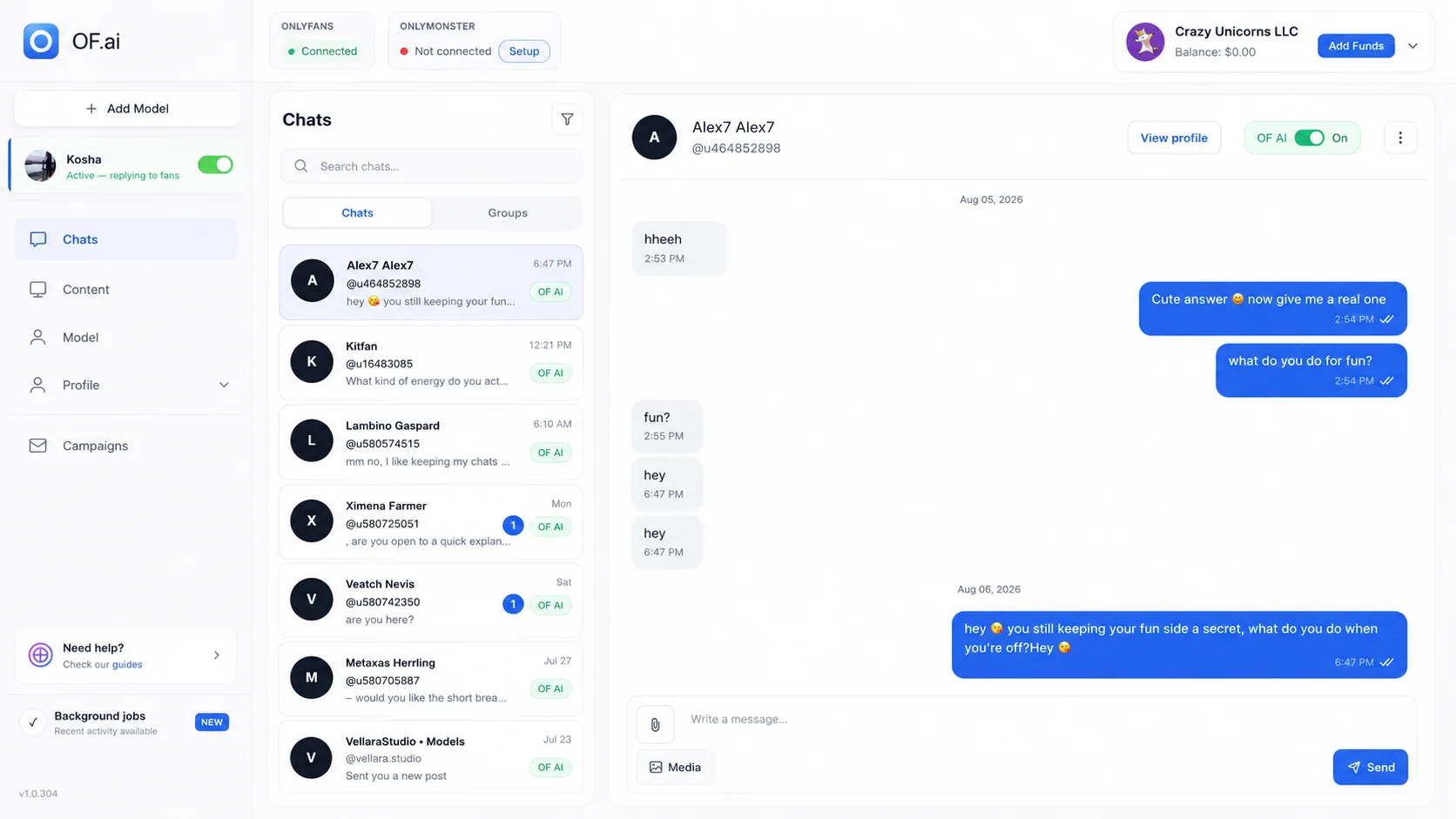
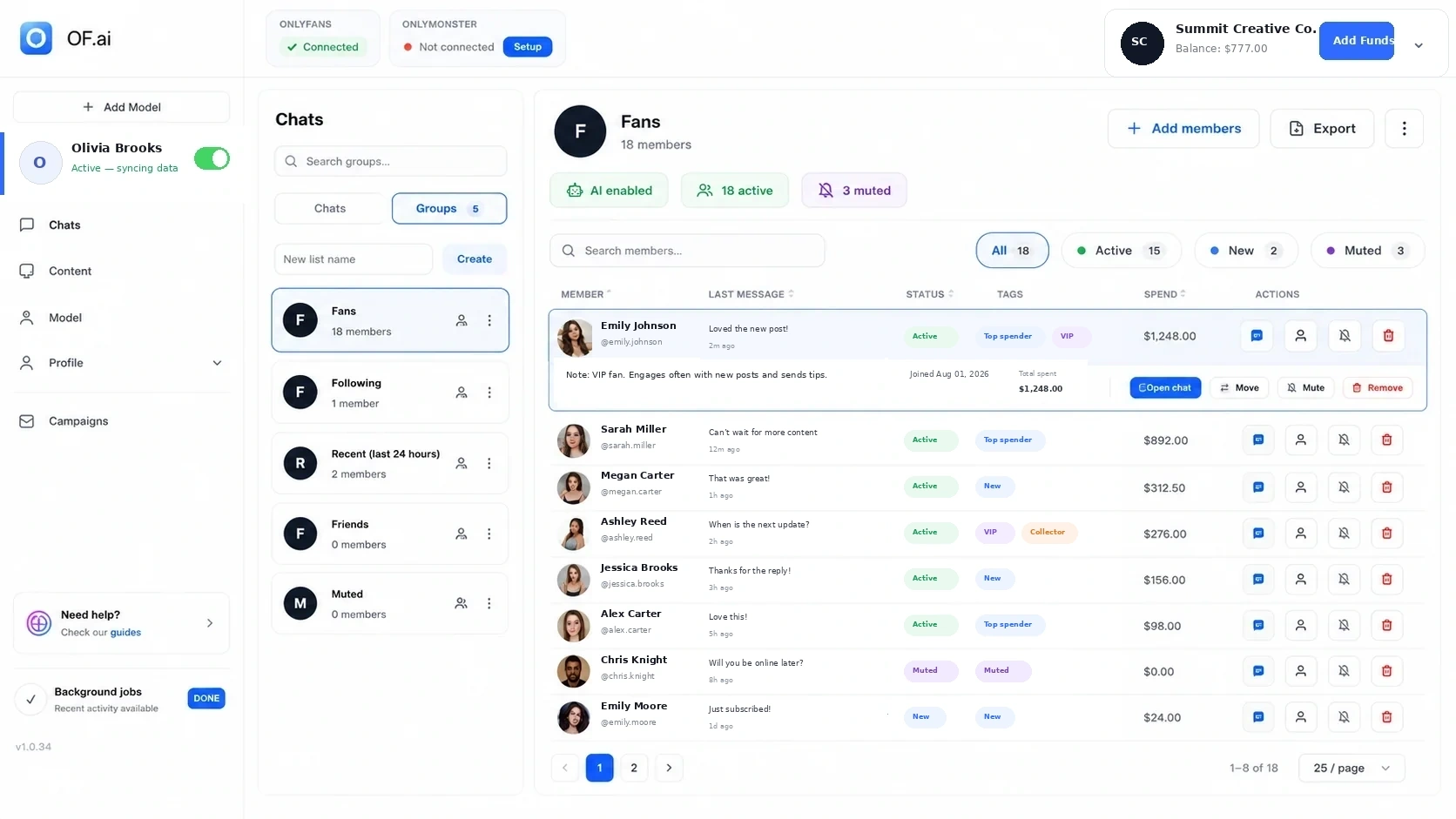
OF.ai brings chat context, fan groups, approved content, configured offer inputs, staged conversation rules, and human takeover into one operating workspace. That can make a controlled offer test easier to execute because the inputs and conversation workflow are visible in the same product surfaces.
Use the screenshots on this page to inspect the current chat, group, and content-library workflow. Then start with one model and one test rather than enabling several revenue changes at once. Expand only when the result survives review, attribution, and total-cost analysis.
FAQ
How can I optimize OnlyFans revenue with AI?
Use AI inside a controlled workflow rather than as a revenue oracle. Test a defined lever such as coverage, offer rules, approved content selection, or follow-up; keep attribution stable; and compare the measured net outcome with your baseline.
Should AI predict subscriber lifetime value?
A predicted LTV is an estimate, not an observed fact. If you use a predictive model, validate it separately and keep the prediction distinct from known purchase history or other observable context.
Should I use a churn risk score to decide who gets offers?
Not as an unquestioned fact. If a churn model exists, validate it and document how it performs. For operational segments, explicit and observable rules are easier to audit.
What should I test first?
Choose the clearest bottleneck in your current workflow and change one major variable where practical. A narrow test is easier to attribute than changing price, content, timing, staffing, and automation together.
How do I know whether a revenue test worked?
Define the cohort, metric, attribution rule, period, and stop conditions before launch. Compare raw counts, rates, operating cost, and review workload with the baseline using the same definitions.
Does more revenue automatically mean positive ROI?
No. Include the cost of producing the result: software, service charges, retained human work, review, corrections, management, and other incremental operating costs.
AI Chatter for OnlyFans.
Start free. Stay free.
Let AI chat with your fans 24/7 using your persona and tone of voice. Keep human control and upgrade only when you want AI selling. Free on the first model of your account; additional models use AI Sexter.